Digital guitar modelers have transformed the way we play. Units like the Neural DSP Quad Cortex, Line 6 Helix, Kemper Profiler, and Fractal Axe-FX pack hundreds of amp and effect models into a single floorboard. They are portable, versatile, and sound incredible — at least through headphones and studio monitors. But ask any guitarist who has made the switch from a tube amp to a modeler about their live experience, and the same complaint surfaces again and again: “It doesn’t feel the same.”
That feeling — the physical sensation of a speaker cone pushing air, the way a guitar cabinet interacts with your picking dynamics, the harmonic feedback loop between amp and instrument — is something that FRFR (Full Range Flat Response) speakers struggle to reproduce. FRFR cabinets are designed to be neutral. They deliver what you feed them, nothing more and nothing less. That neutrality is their greatest strength for studio applications and in-ear monitoring, but it can also be their biggest weakness on stage.
There is, however, a third option that many players overlook: running your modeler through a dedicated power amplifier into a traditional guitar speaker cabinet. This approach combines the tonal versatility of digital modeling with the visceral, physical experience of a real amp and cab. And thanks to a new generation of compact, pedalboard-friendly power amps, it has never been easier or more practical to set up.
The Problem With FRFR for Live Guitar
FRFR speakers work like compact PA systems. They use full-range drivers — typically a woofer paired with a tweeter — to reproduce the entire frequency spectrum as accurately as possible. When your modeler’s output includes a cabinet simulation or impulse response (IR), the FRFR speaker faithfully projects that finished, mic’d sound into the room.
For front-of-house engineers and audiences, this can be great. The tone you dial in is the tone they hear. But for you, the guitarist standing on stage, the experience is different. A traditional guitar speaker is mid-focused, rolls off the high frequencies naturally, and adds its own resonance and compression to the signal. That coloration is not a flaw — it is a fundamental part of what makes a guitar amp sound and feel like a guitar amp.
FRFR cabinets, by contrast, can feel sterile and disconnected. The highs can be harsh, the low end unfocused, and the overall experience lacks the directional punch that a guitar cabinet delivers. Many players describe it as sounding like a recorded tone played back through a PA rather than a living, breathing instrument.
The Power Amp and Real Cab Solution
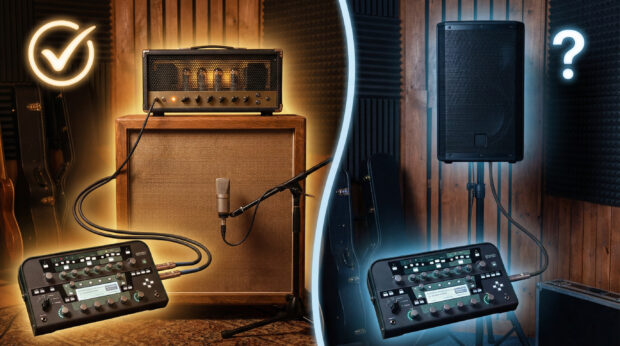
The concept is straightforward. Instead of sending your modeler’s output — complete with cab simulation — into an FRFR speaker, you disable the cabinet modeling in your signal chain and send only the preamp and effects signal into an external power amplifier. That power amp then drives a traditional guitar speaker cabinet, just like a conventional amp head would.
The result is the best of both worlds. You keep all the flexibility of your modeler — hundreds of amp models, effects, presets, and instant patch changes — while regaining the physical response and tonal character of a real guitar speaker. The cabinet’s own resonance, the way it filters frequencies, the way the cone moves air in the room — all of that comes back into your playing experience.
This is not a new idea, but it has gained enormous traction in recent years as modelers have become more sophisticated and the demand for compact, gig-ready solutions has grown. Modern power amps designed specifically for this purpose are small enough to sit on a pedalboard, light enough to carry in a gig bag, and powerful enough to fill a stage.
Victory Amplifiers PowerValve 200: Tube Feel for Your Digital Rig
One of the most exciting recent entries in this category is the Victory Amplifiers PowerValve 200. This compact 200-watt power amplifier was designed from the ground up to serve as the bridge between digital rigs and real guitar cabinets.
What makes the PowerValve 200 unique is its Valve React Circuit (VRC). When engaged, this circuit activates an EF91 (CV4014) tube that adds harmonic richness, natural compression, and touch-sensitive dynamics to the signal before it reaches the speaker. Victory’s chief designer Martin Kidd has explained that the subtle harmonic content generated by this valve stage creates a slight asymmetry in the waveform — and that is precisely where the feel comes from.
This is a crucial distinction from other solid-state power amps. While most pedalboard power amps aim for transparency — amplifying your signal without adding anything to it — the PowerValve 200 gives you the option to inject real tube character into your digital tone. You can switch the VRC on for that warm, dynamic valve response, or leave it off for a cleaner, more transparent amplification. It is the best of both approaches in a single unit.
The PowerValve 200 delivers 200 watts into 4 ohms, 100 watts into 8 ohms, and 50 watts into 16 ohms, making it compatible with a wide range of cabinets. It features a balanced input for modelers, a three-band EQ with Resonance, Body, and Presence controls, an XLR output with switchable analog cab simulation for direct recording or front-of-house feeds, and a dedicated headphone output with independent level control. All of this comes in a remarkably compact enclosure weighing just 1.9 kilograms.
Neural DSP’s Head of Global Sales, Ryan Morgan, tested the PowerValve 200 with the Quad Cortex and praised the results, noting that the added tube stage delivered an immediate improvement to the signal. Victory endorsee and Quad Cortex user Rabea Massaad has also spoken about how the VRC brings his presets to life with an extra tube-amp-style punch that feels great under the fingers.
Seymour Duncan PowerStage 100 Stereo: Transparent Power in Stereo
On the other end of the design philosophy sits the Seymour Duncan PowerStage 100 Stereo. Where the Victory PowerValve 200 offers optional tube coloration, the PowerStage 100 Stereo focuses on delivering your modeled tones with maximum transparency and fidelity — in true stereo.
The PowerStage 100 Stereo provides 100 watts per channel at 4 ohms (50 watts per channel at 8 ohms), with stereo inputs and outputs that let you run two separate cabinets for a full stereo spread. This makes it ideal for players who rely on stereo delays, reverbs, and modulation effects and want to hear those spatial effects reproduced through real speakers on stage.
The unit features a comprehensive five-band EQ section with Bass, Low-Mid, Hi-Mid, Treble, and Presence controls that offer substantial boost and cut across carefully chosen frequency centers. This EQ can be independently engaged or bypassed for both the speaker outputs and the balanced XLR line outputs, giving you separate tonal control for your stage sound and your front-of-house feed.
Built-in analog cab simulation via XLR outputs, a compact pedalboard-friendly enclosure, and an internal power supply (no external wall wart) round out the practical features. Guitar World’s review praised the unit’s sound quality as pristine, with warmth and definition well suited for guitar tones, noting that the output level was more than sufficient for club stages.
The PowerStage 100 Stereo is particularly appealing for players who want to set up a wet/dry/wet rig or simply enjoy the immersive experience of stereo modeled tones through real guitar speakers.
Choosing Between Tube Character and Transparent Amplification
The Victory PowerValve 200 and the Seymour Duncan PowerStage 100 Stereo represent two different philosophies, and the right choice depends on what you value most.
Choose the Victory PowerValve 200 if you miss the feel and interaction of a tube amp. The switchable VRC adds a layer of organic warmth and dynamic response that enhances the connection between your fingers and the speakers. It is a mono unit, so it works best for players who prioritize the raw feel of a single amp and cab setup over stereo imaging.
Choose the Seymour Duncan PowerStage 100 Stereo if you want the most faithful reproduction of your modeled tones and you value stereo capabilities. Its transparent amplification lets your modeler’s character shine without any additional coloration, and the stereo outputs open up possibilities for immersive rig configurations.
Both units are compact enough for pedalboard mounting, powerful enough for live performance, and equipped with direct outputs for recording and front-of-house connections.
How to Set Up Your Modeler With a Power Amp and Real Cab
Setting up this kind of rig is simpler than you might think. Here is the basic signal flow:
Your guitar goes into your modeler as usual. Inside the modeler, you build your signal chain with amp models, effects, and any processing you like — but you disable the cabinet simulation and impulse responses at the end of the chain. The modeler’s output then feeds into the power amp’s input. From the power amp, a standard speaker cable runs to your guitar cabinet.
A few practical tips to keep in mind: Make sure you are sending a line-level signal from your modeler, not a speaker-level signal. Use the power amp’s EQ to fine-tune the interaction between your modeler’s output and your specific cabinet — every speaker sounds different, and a little adjustment goes a long way. If you need a feed for front-of-house, use the power amp’s balanced output with cab simulation engaged, so the sound engineer gets a polished, mic’d tone while you enjoy the raw cabinet sound on stage.
The Best of Both Worlds
Running a guitar modeler through a power amp into a real speaker cabinet is not about rejecting digital technology. It is about embracing it fully while acknowledging that the physical experience of playing through a guitar speaker is something special and worth preserving.
FRFR speakers will continue to serve players who need maximum flexibility and consistency between their stage sound and their front-of-house feed. But for those who have always felt that something was missing from their digital rig — that intangible sense of connection and response — a dedicated power amp and a good guitar cabinet might be the answer.
With products like the Victory PowerValve 200 and the Seymour Duncan PowerStage 100 Stereo, the gap between digital convenience and analog soul has never been narrower. Your modeler handles the brains. The power amp provides the muscle. And the real speaker cabinet delivers the heart.
It is time to let your digital rig breathe through a real cabinet. Your fingers will thank you.