Summary: Best Use Cases (Concurrent Delay Pairings)
Here’s where things get practical:
🎧 1. Classic Dual Delay Setup
- DD-8 (clean digital) + Carbon Copy (analog)
✔ Tight rhythm + warm depth
🌊 2. Ambient Soundscapes
- El Capistan V2 + Flamma FS22
✔ Tape texture + lush reverb wash
🎚️ 3. Studio / Pro Rig
🔁 4. Vintage + Modern Hybrid
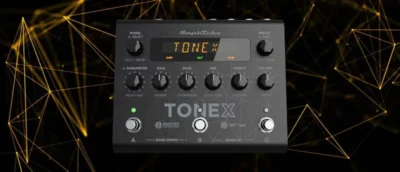
🎛️ 5. All-in-One Minimal Setup
⚖️ Quick Verdict (By Category)
| Category | Best Choice |
|---|---|
| Beginner / Budget | Harley Benton / Flamma FS22 |
| Classic Tone | Carbon Copy (analog) / El Capistan |
| Vintage Tape | RE-202 |
| Versatility | DL4 MKII |
| Pro / Studio | Timeline / Collider |
| Concurrent Delay King | Collider or Timeline |
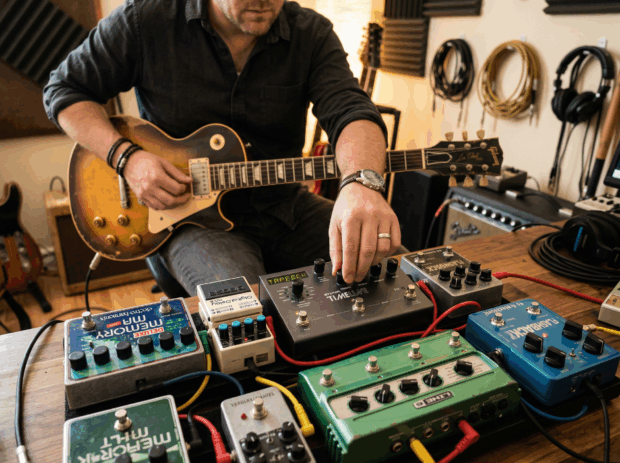
Delay has always been one of the most expressive tools in a guitarist’s rig—but running multiple delays at once (concurrent delays) takes things to a completely different level. Instead of a single echo repeating behind your notes, concurrent delay setups create layered rhythmic textures, ambient washes, and complex spatial effects that can transform even simple playing into something cinematic.
What Are Concurrent Delay Pedals?
“Concurrent delay” refers to using two or more delay effects simultaneously, either:
- Through stacked pedals (one feeding into another), or
- Via multi-delay units that run separate delay lines in parallel
Each delay can have its own time, feedback, mix, and modulation, allowing you to craft highly detailed soundscapes.
Why Use Multiple Delays?
1. Rhythmic Complexity
Combining different delay times creates interlocking rhythms. For example:
- One delay at quarter notes
- Another at dotted eighths
This produces a groove that feels almost like a second guitarist playing along.
2. Ambient Depth
Stacking delays with long repeats creates lush, evolving backgrounds—perfect for ambient, post-rock, or worship styles.
3. Stereo Imaging
Running delays in stereo spreads repeats across left and right channels, giving your tone width and dimension.
4. Creative Expression
You’re no longer limited to a single echo—you can design entire sonic environments.
Common Ways to Run Concurrent Delays
Serial (Stacked)
- Guitar → Delay 1 → Delay 2 → Amp
- The second delay processes the repeats of the first
- Result: denser, cascading echoes
Parallel
- Signal splits into two delays, then recombines
- Result: cleaner, more defined repeats
Multi-Engine Pedals
Modern delay units allow multiple delay lines internally:
- Easier to control
- Often include presets and sync options
Essential Delay Settings for Guitarists
Here are some tried-and-true delay settings you can use—whether running a single delay or combining multiple.
🎸 1. Slapback Delay (Rockabilly / Classic Rock)
- Time: 80–120 ms
- Feedback: 1–2 repeats
- Mix: Low (10–20%)
Tip: Pair with a longer delay for a subtle depth boost.
🎸 2. Rhythmic Delay (Dotted Eighth)
- Time: Sync to dotted 8th notes
- Feedback: Medium (3–5 repeats)
- Mix: Medium (25–40%)
Tip: Combine with a quarter note delay for iconic rhythmic interplay.
🎸 3. Ambient Wash
- Time: 500–800 ms
- Feedback: High (6–10 repeats)
- Mix: Medium-high (40–60%)
Tip: Add modulation or reverb after the delays for huge atmospheric sounds.
🎸 4. Lead Delay (Solo Boost)
- Time: 300–450 ms
- Feedback: Medium
- Mix: 20–30%
Tip: Use a second delay with longer time for added sustain without clutter.
🎸 5. Dual Delay Setup (Concurrent Example)
Delay 1 (Rhythm):
- Time: Dotted 8th
- Feedback: Medium
- Mix: 30%
Delay 2 (Ambient):
- Time: 600 ms
- Feedback: High
- Mix: 40%
Result: Clear rhythmic repeats with a spacious tail behind them.
Tips for Dialing in Concurrent Delays
- Start simple: Begin with one delay, then add a second
- Watch the mix levels: Too much delay can muddy your tone
- Use tap tempo: Keeps multiple delays in sync
- EQ your repeats: Roll off highs/lows to avoid clutter
- Experiment with order: Swapping pedal order changes everything
how different delay lines interact, you’ll find yourself designing sounds that are uniquely yours.
Full Delay Pedal Comparison
Simple & Budget-Friendly Delays
Boss DD-8 Digital Delay
- Type: Digital (multi-mode)
- Key features: 10 delay modes, looper, stereo
- Sound: Clean, versatile
- Best for: First “serious” delay or compact multi-use
👉 Great as a foundation delay in concurrent setups (e.g. rhythmic layer)
Harley Benton Digital Delay
- Type: Basic digital
- Key features: Minimal controls, very affordable
- Sound: Simple, no-frills
- Best for: Beginners or secondary slapback
👉 Works as a secondary always-on delay if budget is tight
Flamma FS22 Delay & Reverb
- Type: Multi-effect (delay + reverb)
- Key features: Presets, stereo, ambient focus
- Sound: Modern, ambient-friendly
- Best for: Compact ambient setups
👉 Excellent for parallel ambient layer alongside another delay
🎸 Classic & Character Delays
MXR M169 Carbon Copy Analog Delay
- Type: Analog
- Key features: Warm repeats, modulation
- Sound: Dark, organic
- Best for: Vintage tones & subtle depth
👉 Perfect as a “glue delay” behind a digital unit
💡 Analog + digital = classic concurrent combo
Boss RE-202 Space Echo Delay/Reverb
- Type: Tape-style digital emulation
- Key features: Multi-head tape echo, built-in reverb
- Sound: Vintage, saturated, evolving
- Best for: Ambient, dub, cinematic textures
👉 Ideal as the main character delay in a dual setup
💡 Based on the legendary Space Echo sound
Strymon El Capistan V2
- Type: Tape echo emulation
- Key features: Wow/flutter, tape age, spring reverb
- Sound: Extremely musical, organic
- Best for: Tape lovers & expressive playing
👉 Works beautifully paired with a clean digital delay
🚀 Modern Multi-Delay Powerhouses
Line6 DL4 MKII Delay
- Type: Multi-delay + looper + reverb
- Key features: 30 delay types, looping, presets
- Sound: Covers everything
- Best for: Players who want “everything in one box”
👉 Can replace an entire concurrent setup alone
💡 Known for huge versatility and delay variety
Source Audio SA 263 Collider Delay+Reverb
- Type: Dual engine (delay + reverb simultaneously)
- Key features: Two effects at once, presets, MIDI
- Sound: Studio-quality, highly configurable
- Best for: True parallel delay + reverb rigs
👉 One of the best pedals for built-in concurrent delays
Boss SDE-3 Delay
- Type: Digital (rack-style emulation)
- Key features: Studio-style delay tones
- Sound: Clean, precise, slightly vintage digital
- Best for: Studio tones & stereo rigs
👉 Great for clean rhythmic delays in layered setups
Strymon Timeline
- Type: High-end digital multi-delay
- Key features: 12 delay machines, 200 presets, MIDI
- Sound: Studio-grade, ultra-polished
- Best for: Professionals & deep tweaking
👉 The ultimate concurrent delay brain
💡 Offers massive preset control and flexibility

🎯 Final Thoughts
Not all delay pedals are equal when it comes to concurrent setups:
- Simple pedals (DD-8, Carbon Copy) shine when paired together
- Character pedals (El Capistan, RE-202) define your tone
- Modern units (Timeline, Collider) can replace entire rigs
The real magic happens when you combine different delay types:
- Digital = clarity
- Analog = warmth
- Tape = movement
That contrast is what makes concurrent delay rigs sound huge, musical, and alive.